

10 Evidences That Strengthen the Case for the Bible #1
Many people dismiss the Bible with a simple statement: “It’s just a book written by men thousands of years ago.”
At first glance, that claim may sound reasonable. After all, the Bible was written by human authors. But so were nearly all the historical and scientific works that shape what people believe about the world today.
The reality is that the Bible stands on far more than blind faith. Over centuries, historians, scholars, archaeologists, and theologians have examined its claims, its manuscripts, its historical context, and its message. What they have found is a body of evidence that is surprisingly strong and remarkably consistent.
This series will explore ten different lines of evidence that point to the reliability of the Bible and the truth of its message.
Each day we will look at one piece of evidence, not as a debate tactic, but as an invitation to think honestly about the question many people ask:
Is the Bible trustworthy?
Evidence #1
The Universal Sense of Morality Points to a Moral Lawgiver
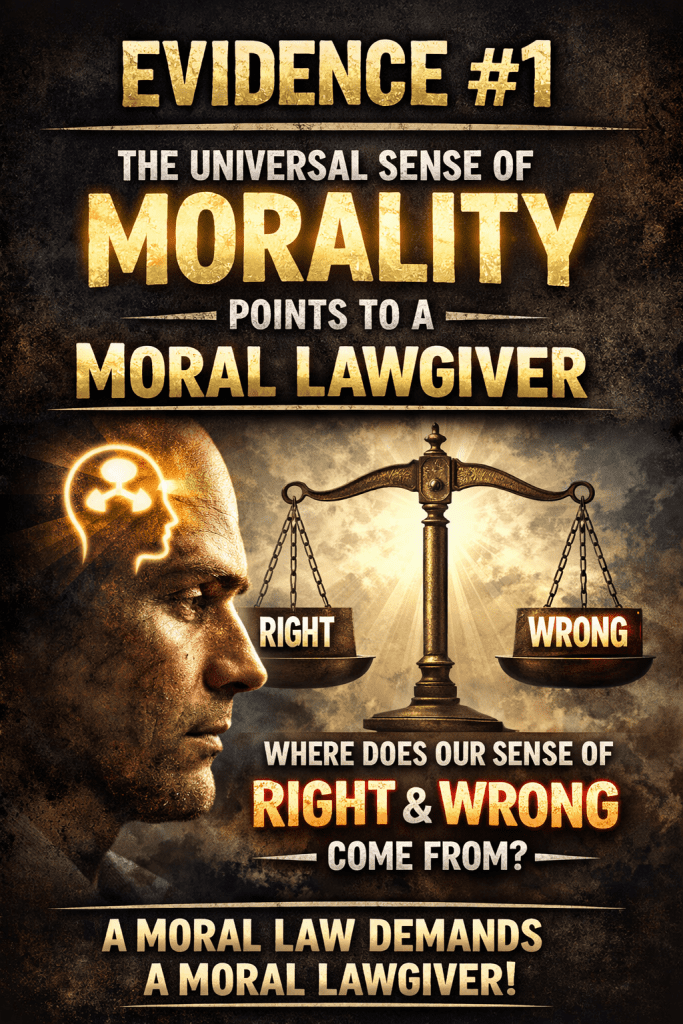
One of the most overlooked pieces of evidence for God is something every human being experiences every day: our sense of right and wrong.
No matter where you go in the world, people recognize that certain things are wrong. Murder, betrayal, cruelty, and injustice are condemned across cultures and across time. Even societies that disagree about many things still maintain moral boundaries.
But this raises an important question.
Where does that moral standard come from?
If morality were merely a product of personal opinion or cultural preference, then no action could truly be called right or wrong. At best we could only say that we personally dislike certain behaviors.
Yet people do not live that way.
When someone commits an act of cruelty, people do not simply say, “That’s not my preference.” They say, “That is wrong.” Not wrong for them personally. Wrong in an objective sense.
That instinct reveals something important about human nature. We live as though there is a real moral law that exists beyond individual opinion.
Philosophers have wrestled with this question for centuries. If there is a moral law that applies to all people, then it logically points to something greater than human agreement.
Laws require a lawgiver.
Just as physical laws point to order in the universe, moral laws point to a source of moral authority.
This is exactly what the Bible describes. Scripture teaches that human beings are created by God and that He has written His moral law on the human heart. Even people who have never opened a Bible still possess a conscience that recognizes good and evil.
This explains why people everywhere wrestle with guilt, justice, forgiveness, and accountability. Those ideas do not come from random chemical reactions in the brain. They reflect a deeper reality about the way humanity was created.
Our moral awareness does not prove every detail about God, but it points strongly in one direction.
If there is a moral law, there must be a moral lawgiver.
And that realization opens the door to the greater message the Bible reveals: that the same God who gave the moral law also made a way for humanity to be forgiven when we fail to live up to it.
Tomorrow we will examine the second evidence in this series: the design and fine-tuning of the universe.
Discover more from Scott A Marshall
Subscribe to get the latest posts sent to your email.
