

Ashes, Dust, and the Power of God
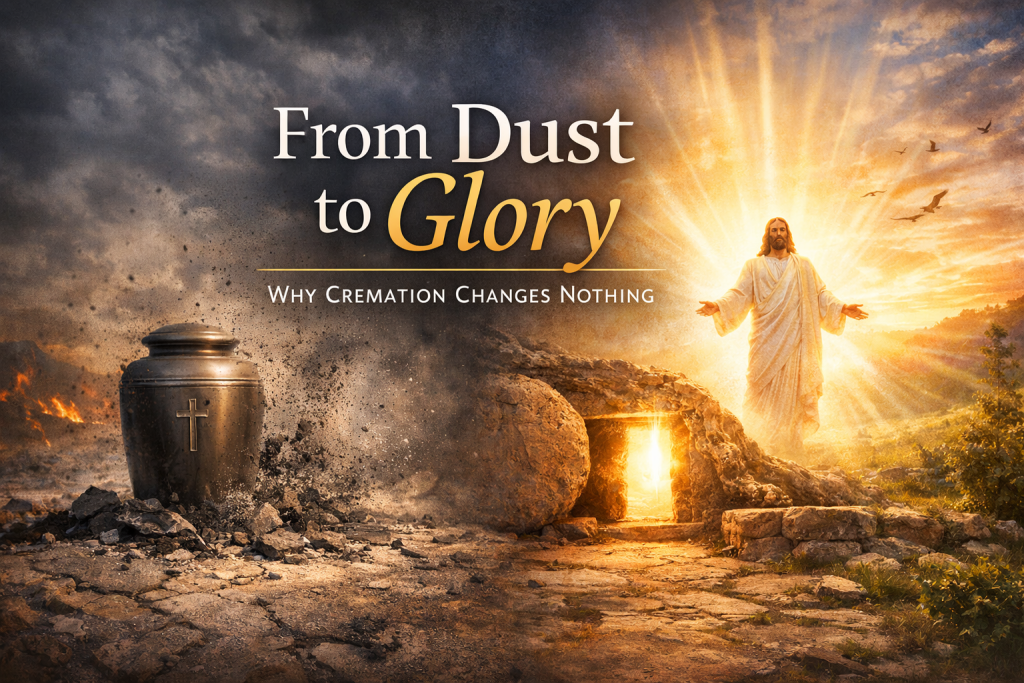
It’s interesting how often this question comes up (twice just this week), and usually it isn’t really about cremation. It’s about fear. It’s about wondering if something done to the body could somehow interfere with what God has promised about eternity.
And when you slow down and really think about it, the concern starts to unravel pretty quickly.
If cremation somehow prevented resurrection, then what are we saying about the countless people throughout history whose bodies were never intact to begin with? Soldiers who were blown apart in war. Victims of fires. People lost at sea. Those who decomposed into dust centuries ago. Are we really suggesting that God’s ability to restore a body depends on the condition we leave it in?
That’s not a biblical concern. That’s a human one.
The Bible never teaches that the preservation of the body is what enables resurrection. In fact, it teaches the exact opposite. The body, in whatever form it takes after death, returns to dust. Genesis 3:19 says, “for you are dust, and to dust you shall return.” That is true whether someone is buried in a casket, laid in a tomb, lost in the ocean, or reduced to ashes through cremation. The process may look different, but the outcome is the same. The body breaks down.
And yet Scripture is clear that this is not the end of the story.
In John 5:28–29, Jesus says, “an hour is coming when all who are in the tombs will hear his voice and come out.” Notice that He doesn’t qualify that statement based on the condition of the remains. He doesn’t say “those whose bodies were properly preserved.” He says all. The authority is not in the body. The authority is in His voice.
Paul takes it even further in 1 Corinthians 15:42–44: “So is it with the resurrection of the dead. What is sown is perishable; what is raised is imperishable. It is sown in dishonor; it is raised in glory.” The entire point is transformation. The body that is buried is not the body that is raised. It is changed, glorified, made new.
That means resurrection is not a reconstruction project where God is limited by what’s left. It is a re-creation by the same God who formed man from the dust in the first place.
Think about that for a moment.
If God could take dust and breathe life into it in the beginning, why would ashes be a problem now?
The concern over cremation often comes from tradition or from the fact that burial is the more commonly seen practice in Scripture. And that’s true. Many were buried. Tombs are mentioned. There is a sense of honor and care shown in how bodies were handled. But descriptive is not the same as prescriptive. The Bible records what was done, but it does not command burial as the only acceptable method.
What Scripture does emphasize is not the method, but the meaning.
The body matters because it was created by God. It should be treated with respect. But our hope is not in preserving the body. Our hope is in the promise of resurrection through Christ.
Philippians 3:20–21 says, “But our citizenship is in heaven, and from it we await a Savior, the Lord Jesus Christ, who will transform our lowly body to be like his glorious body to be like his glorious body, by the power that enables him even to subject all things to himself.”
That’s where the confidence comes from. Not in what happens to the body after death, but in the power of Christ over all things.
Cremation doesn’t challenge that power. It doesn’t limit God. It doesn’t interfere with resurrection. If anything, it actually highlights the truth that our hope was never in the physical remains to begin with.
The early concern people sometimes carry is rooted in the idea that the body needs to stay intact so it can be raised. But Scripture consistently points us away from that line of thinking. What is buried is perishable. What is raised is imperishable. What goes into the ground—or is reduced to ashes—is not what comes out in eternity. It is transformed.
That means the question isn’t, “What happens to the body?” The real question is, “What has Christ promised?”
And He has already answered that.
In John 11:25, Jesus says, “I am the resurrection and the life. Whoever believes in me, though he die, yet shall he live.” That promise doesn’t come with conditions about burial methods. It rests entirely on faith in Him.
So when someone asks whether cremation is wrong, the better way to approach it is to shift the focus. Not to argue about fire versus burial, but to bring it back to the authority and sufficiency of God.
The same God who numbers the hairs on your head is not confused by where your atoms end up. The same God who created the universe out of nothing is not limited by whether a body decomposed naturally or was cremated.
There is no scenario where God looks at a set of remains—whether scattered, burned, lost, or long gone—and says, “This one is beyond my reach.”
That’s not the God of the Bible.
The real danger is not in cremation. The real danger is in placing confidence in anything other than Christ. People can get so focused on the method of death and burial that they lose sight of the condition of the soul.
Because in the end, resurrection is not about how well the body was preserved. It is about whether the person belonged to Jesus.
That’s the difference that matters.
Cremation is a physical process. Resurrection is a divine promise. And those two are not in conflict.
Discover more from Scott A Marshall
Subscribe to get the latest posts sent to your email.
