

The Gospel Is Not an Escape Plan
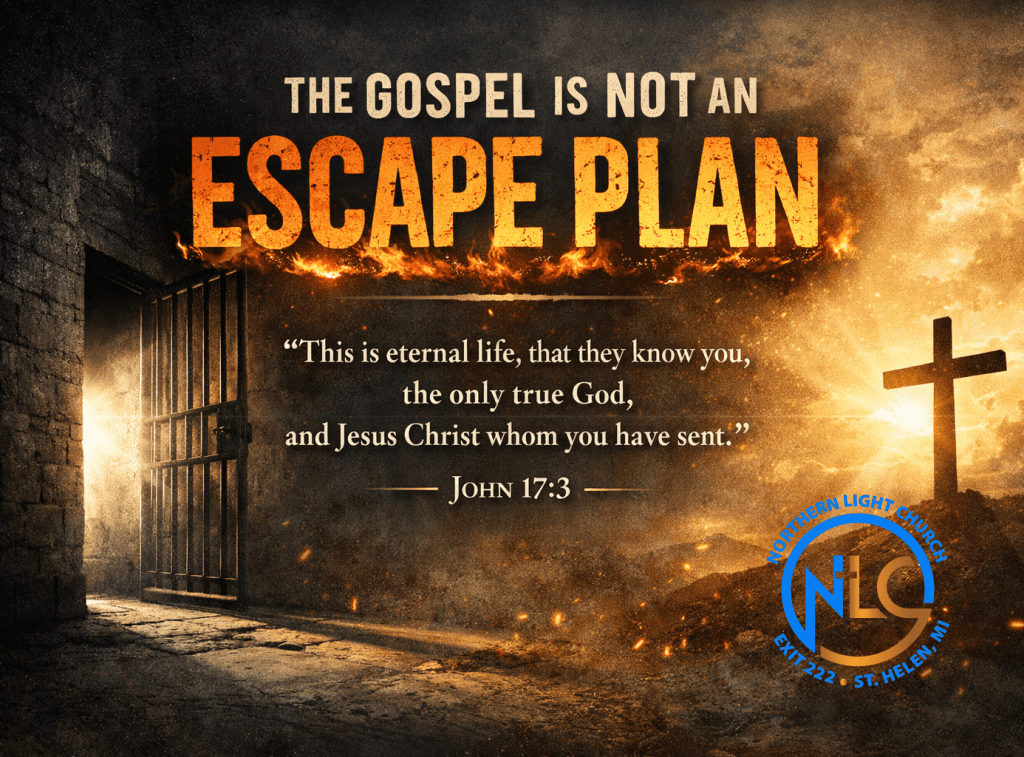
If your only motivation for heaven is not going to hell, you’ve missed the entire point.
That may sound blunt, but stay with me for a minute, because this matters more than most people realize. I talk to people all the time—at church, in the jail, and around our community—and when the subject of salvation comes up, the conversation often lands in the same place. The focus is on avoiding hell, avoiding punishment, and avoiding the worst-case scenario. Now to be clear, the Bible does not pretend hell isn’t real. Jesus Himself spoke plainly about judgment, and there is nothing unloving about warning someone that eternity matters. But this is where many people stop too soon.
The gospel was never meant to be reduced to a cosmic fire escape plan. Salvation is not primarily about what you are rescued from; it is about who you are rescued to. Jesus made this clear in John 17:3 when He said, “This is eternal life, that they know you, the only true God, and Jesus Christ whom you have sent.” Eternal life is not merely endless existence in a better location. It is knowing God, walking with Him, and being restored to the relationship we were created for in the first place. When you see it that way, the whole picture changes. We are no longer just talking about fear—we are talking about fellowship. Not just escape, but restoration. Not just avoiding punishment, but receiving new life.
Many people quietly misunderstand what salvation really is. Some treat it like spiritual insurance. They want just enough Jesus to feel safe, but not enough to actually surrender. They want the benefits of heaven without the lordship of Christ. They want forgiveness without transformation. But the Bible does not describe salvation that way. Second Corinthians 5:17 says that if anyone is in Christ, he is a new creation; the old has passed away and the new has come. That is strong language. Scripture is not describing improved behavior or religious affiliation. It is describing real, internal change that begins in the heart and then works its way outward into a person’s life.
Now, does fear ever play a role at the beginning? Yes, it can. Proverbs 9:10 tells us that the fear of the Lord is the beginning of wisdom. Beginning is the key word. Fear can wake someone up. It can shake a person out of spiritual complacency and force them to think seriously about eternity. But fear was never meant to carry the whole weight of your faith. Fear alone tends to produce avoidance, while love produces surrender. Romans 2:4 reminds us that it is God’s kindness that leads us to repentance. When someone begins to truly see Christ—not just as Judge, but as Savior; not just as holy, but as merciful; not just as powerful, but as personal—something shifts inside. The question moves from “How do I stay out of hell?” to “How do I belong to Him?” That is the turning point.
Maybe as you read this, you recognize that much of your own spiritual thinking has been driven by fear. Maybe you grew up hearing about judgment and learned just enough Bible to feel uneasy about eternity. Maybe you have even prayed a prayer at some point, but deep down you are not sure anything really changed. It is important to say this plainly and gently: salvation is not about reciting the right words; it is about responding to the right Person.
Scripture tells us in Romans 3:23 that all have sinned and fall short of the glory of God. Every one of us. Sin is not only the obvious outward failures; it is the condition of a heart that has lived independently from the God who made it. Because of that, sin carries real consequences. Romans 6:23 explains that the wages of sin is death, but the verse does not end there. It continues by saying that the free gift of God is eternal life in Christ Jesus our Lord. That is the heart of the gospel. God did not leave us to fix ourselves. Jesus lived the life we could not live and died the death we deserved to die. On the cross He fully paid for sin, and three days later He rose again, proving the payment was accepted and the victory was secure.
Salvation, then, is not earned by good behavior; it is received through genuine repentance and faith in Christ. Near the end of this conversation, it is worth hearing the clarity of Romans 10:9–10, which says, “If you confess with your mouth that Jesus is Lord and believe in your heart that God raised him from the dead, you will be saved. For with the heart one believes and is justified, and with the mouth one confesses and is saved.” Notice how Scripture ties belief in the heart together with confession of the mouth. One is not meant to be empty words, and the other is not meant to remain hidden. Real faith engages both.
So if you sense the Spirit of God pressing on your heart, you can respond right where you are. You do not need perfect language, and you do not need a church building. You simply come honestly before Him. A person might pray something like this: “Lord, I know I’ve sinned. I know I’ve been living my way instead of Yours. I believe Jesus died for me and rose again. I’m not just asking to avoid judgment—I’m asking You to take my life. Forgive me, change me, and I surrender to You.”
But hear this clearly as we close: it is not the specific words of a prayer that save anyone. Scripture never teaches that salvation comes from repeating a formula. What matters is the genuine posture of the heart behind the words—repentance that is real, faith that is sincere, and a willingness to surrender to Christ as Lord. When that is present, the promise of God stands firm. And when that happens, the journey of salvation is not ending in relief; it is just beginning in new life.
