

When Evil Makes People Doubt God
The Epstein Files, Human Sin, and the Justice That Is Coming
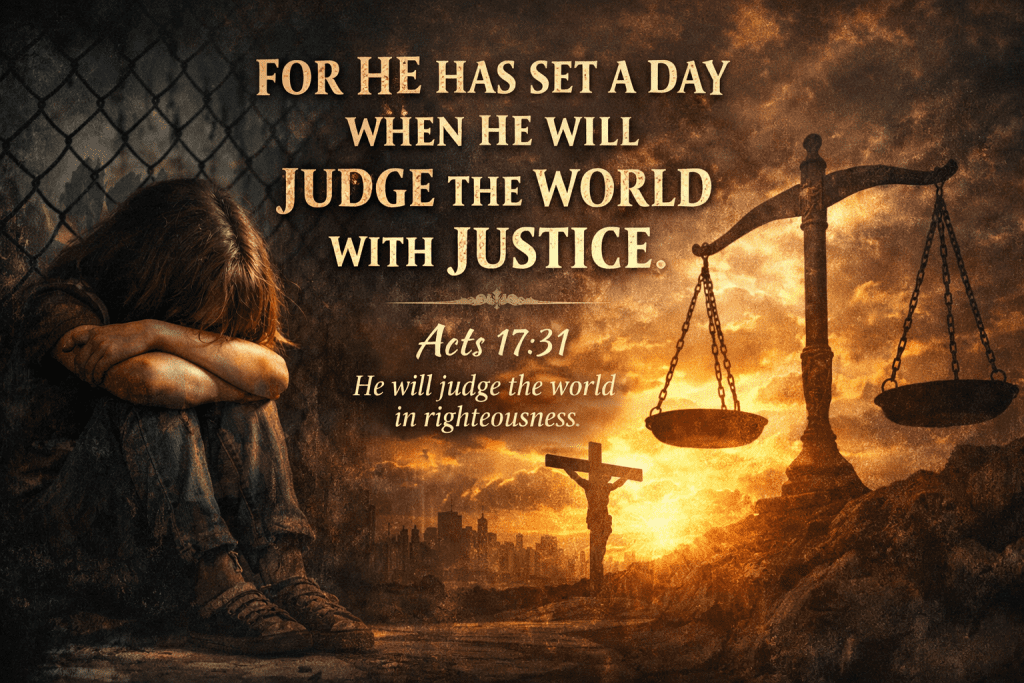
Over the past several years, the world has been repeatedly confronted with the horrifying reality of child exploitation and trafficking. The renewed attention around the Epstein files has only intensified that awareness. What has been exposed is sickening. Children — the most vulnerable among us — were treated as commodities by people with power, wealth, and influence.
Let’s be clear from the start: what happened in those cases is not just disturbing. It is evil in the deepest sense of the word.
And for many people, this kind of evil raises a painful question:
“If God exists, why doesn’t He stop this?”
It is an emotional question. It is an understandable question. But it is also a question that deserves a thoughtful and truthful answer. Because while the existence of evil is often used as an argument against God, the reality is that evil itself actually points us toward the truth about God, not away from Him.
Where Sin Came From
To understand why atrocities like trafficking exist, we have to go back to the beginning.
The Bible teaches that God did not create a world filled with abuse, violence, and corruption. Genesis 1:31 tells us that when God finished creation, “God saw everything that He had made, and behold, it was very good.”
What changed was not God’s character. What changed was humanity’s rebellion.
When sin entered the world in Genesis 3, it did not just introduce minor flaws into human behavior. It corrupted the human heart. Romans 5:12 explains that sin entered the world through one man, and death through sin, and so death spread to all men because all sinned.
From that point forward, humanity has demonstrated an increasing capacity for moral darkness. History is not a steady march toward moral perfection. It is a repeated display of what happens when human beings reject God’s authority and pursue their own desires without restraint.
The Epstein scandal is not evidence that God is absent. It is evidence that the Bible’s diagnosis of the human condition is painfully accurate.
Why God Allows Evil to Exist
This is where the conversation often becomes difficult.
Scripture teaches that God created human beings with real moral agency. From the beginning, humanity was given the ability to obey or to rebel. That freedom is what makes love, obedience, and righteousness meaningful — but it also opens the door to real evil.
Much of the suffering we see in the world today is not the result of God actively causing harm. It is the result of humans doing exactly what sinful humans do when they reject God’s moral boundaries.
James 1:14–15 explains it plainly: each person is tempted when he is lured and enticed by his own desire. Then desire when it has conceived gives birth to sin, and sin when it is fully grown brings forth death.
In other words, the pipeline from human desire to human destruction is not new. It has been operating since the fall.
Now, someone might say, “But God could stop it.”
Yes — He could.
But if God immediately intervened to stop every evil action before it occurred, we would no longer be living in a world where humans make real moral choices. We would be living in a controlled environment where freedom is only an illusion.
And there is another uncomfortable truth many people do not consider: the same instant justice people demand for traffickers would, if applied consistently, fall on every human being who has ever sinned.
Scripture says in Romans 3:23 that all have sinned and fall short of the glory of God. The human problem is not isolated to the worst headlines. It runs through the entire human race.
The Moral Argument People Don’t Notice
There is another layer to this conversation that often goes unspoken.
When people hear about the exploitation of children — and rightly feel outraged — they are making a moral judgment. They are not merely saying, “I personally don’t like this.” They are saying something much stronger:
“This is truly wrong.”
But that raises an important question we cannot ignore:
On what basis is it truly wrong?
To understand the weight of that question, we need to make a very simple distinction that often gets overlooked — the difference between subjective and objective.
Subjective vs. Objective (In Plain Terms)
Subjective means something is based on personal opinion, preference, or feeling.
For example:
- I like vanilla ice cream.
- You like chocolate.
- Neither of us is morally wrong.
That is subjective. It depends on the person.
But objective is different.
Objective means something is true regardless of what anyone thinks or feels. It is fixed. It does not change with opinion.
For example:
- Two plus two equals four whether you like it or not.
- Gravity works whether you believe in it or not.
That is objective truth.
Now bring that back to the issue at hand.
When people talk about crimes against children, they are not speaking in subjective language like food preferences. No one says:
“Well, trafficking is just something I personally don’t prefer.”
No — people say:
- “That is evil.”
- “That is wrong.”
- “That should never happen.”
Why?
Because deep down, we all know this is not a matter of opinion. We recognize it as objectively wrong.
Here Is the Logical Tension
If the universe is ultimately the product of blind, unguided processes — if there is no moral Lawgiver — then moral claims cannot be truly objective. They can only be personal or cultural preferences.
Without God, the most someone can honestly say is:
“I strongly dislike this.”
But almost no one actually talks that way.
Your neighbor doesn’t.
The news anchor doesn’t.
The skeptic doesn’t.
When they speak about the abuse of children, they speak as if real moral lines have been crossed — because in their hearts, they know they have.
Scripture explains why.
Ecclesiastes 3:11 says God has set eternity in the human heart.
Romans 2:15 says the work of the law is written on the heart.
In other words, the moral alarm that goes off inside us is not an accident. It is part of how we were made.
The very outrage people feel over evil is actually evidence of something deeper.
It shows that we instinctively recognize:
- Some things are truly right.
- Some things are truly wrong.
- And those truths exist above human opinion.
That moral reality does not float in midair. It points to a moral Lawgiver.
The evil we see in the world does not disprove God.
If anything, our universal recognition of evil is one of the clearest fingerprints that He is there.
God Is Not Indifferent
Another dangerous misunderstanding is the idea that God is somehow passive or unconcerned about the abuse of the innocent.
Nothing could be further from the truth.
Throughout Scripture, God repeatedly identifies Himself as the defender of the vulnerable and the judge of the wicked. Psalm 10 speaks of the wicked who prey on the helpless and makes clear that the Lord sees and will call them to account.
Jesus Himself gave one of the strongest warnings in all of Scripture regarding those who harm children. In Matthew 18:6, He says that whoever causes one of these little ones who believe in Him to sin, it would be better for him to have a great millstone fastened around his neck and to be drowned in the depth of the sea.
That is not the language of indifference. That is the language of coming judgment.
Justice Delayed Is Not Justice Denied
Here is where many people lose perspective.
We live in the middle of the story, not at the end of it.
The Bible is clear that God has appointed a day when He will judge the world in righteousness. Acts 17:31 says exactly that. Every hidden crime, every secret exploitation, every abuse of power that escaped human courts will be fully exposed and fully judged.
No trafficker ultimately gets away with anything.
Some will face justice in this life. Others will face it in the next. But Scripture leaves no room for the idea that God simply shrugs at evil and moves on.
Second Peter 3:9 explains that the Lord is not slow concerning His promise, but is patient, not wishing that any should perish but that all should reach repentance. What looks like delay is actually mercy — time for repentance before judgment falls.
The Cross: God Entered Our Suffering
Perhaps the most important truth in this entire discussion is this: Christianity does not present a distant God watching human suffering from afar.
In Jesus Christ, God stepped directly into the brokenness of this world.
He experienced betrayal. He experienced injustice. He experienced violence at the hands of corrupt human systems. The cross is not God ignoring evil. It is God confronting evil at the deepest level — taking the penalty of sin upon Himself so that redemption could be possible.
The existence of evil is not evidence that God is absent. The cross is evidence that God has already begun the process of defeating it.
The Bottom Line
The horrors exposed in cases like Epstein’s should grieve us. They should anger us. They should drive us to protect the vulnerable and pursue justice wherever we can.
But they should not lead us to conclude that God does not exist.
If anything, they confirm exactly what Scripture has been saying all along:
- The human heart is deeply fallen.
- Sin produces real devastation.
- Moral evil is real and will be judged.
- And God has not been silent — He has spoken, He has warned, and He has acted through Christ.
The headlines are not the final chapter.
Justice is coming.
Discover more from Scott A Marshall
Subscribe to get the latest posts sent to your email.
