

You Don’t Get To Call It Love If You Won’t Tell The Truth
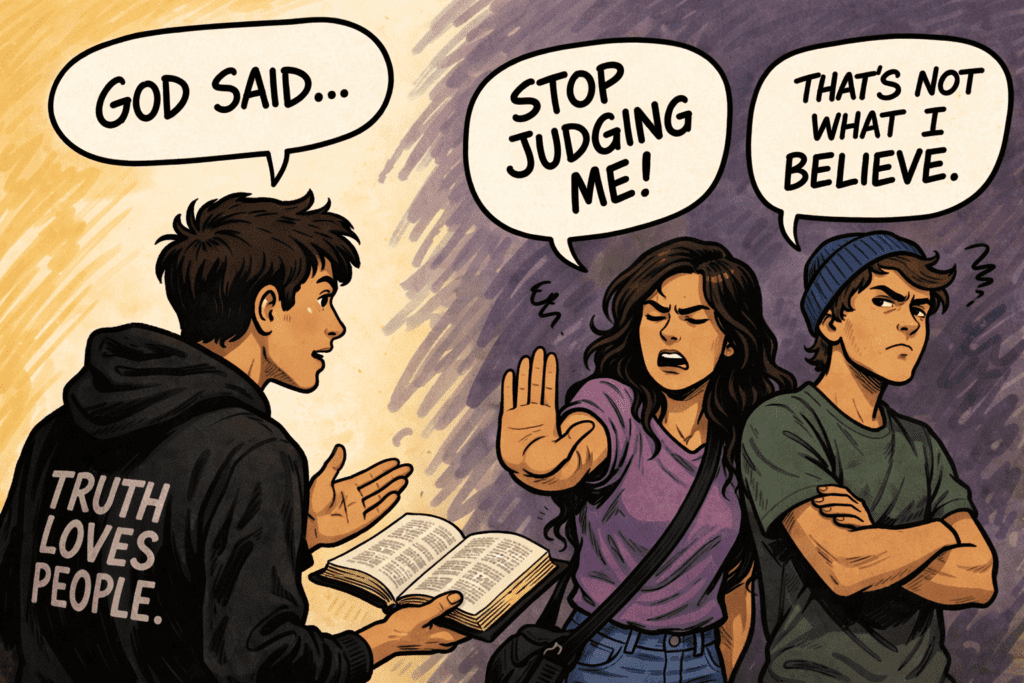
Nobody wants to be called judgmental. It lands like an accusation and it’s designed to. The moment someone levels that word at you, the conversation shifts. Suddenly you’re on trial and whatever point you were making is buried under the need to defend your character. It’s an effective weapon because most people would rather retreat than fight, and the culture knows it.
But here’s what’s actually happening. When a biblical worldview collides with a cultural one, the culture doesn’t engage the argument. It attacks the person making it. Call them intolerant. Call them hateful. Call them judgmental. It’s a silencing tactic dressed up as moral concern and it works because Christians have largely forgotten what they believe and why they believe it. You can’t defend a position you’ve never studied. You can’t stand on ground you’ve never walked. And when the pushback comes — and it always comes — the Christian who doesn’t know their Bible doesn’t just lose the argument. They start to wonder if maybe the culture has a point.
That’s the real damage. Not the argument lost. The doubt that moves in afterward.
The church has produced a generation of believers who are genuinely good people with genuinely soft convictions. They feel their faith more than they know it. And feeling is not enough when someone gets in your face and tells you that your beliefs are dangerous. 2 Timothy 4:3-4 says “the time will come when people will not put up with sound doctrine. Instead, to suit their own desires, they will gather around them a great number of teachers to say what their itching ears want to hear. They will turn their ears away from the truth and turn aside to myths.” That is not a prophecy about some distant future. It is a description of right now. And the Christian who has never seriously engaged the Word has no armor against it. You need to know what God actually said and why it matters and why you’re not budging. That knowledge doesn’t come from a podcast or an Instagram quote. It comes from being in the Word consistently, and from being planted in a community of believers who sharpen you, challenge you, and won’t let you drift.
Because drifting is the quiet danger nobody talks about. It doesn’t happen dramatically. Nobody walks away from their faith in a single moment of crisis. They just slowly absorb the culture around them because they never built anything strong enough to resist it. The cultural definition of love gets into them by degrees. Affirm people. Validate their choices. Never say anything that makes anyone uncomfortable. And before long the Christian who once had convictions is just a nicer version of everyone else, standing for nothing, offending no one, and helping nobody.
That is not love. That has never been love.
Love tells the truth. Not because truth is easy or because saying hard things feels good, but because silence in the face of someone heading toward destruction is not kindness. It is cowardice. Proverbs 27:6 says “wounds from a friend can be trusted, but an enemy multiplies kisses.” Read that slowly. The person telling you what you want to hear may be the most dangerous person in your life. The doctor who sees the cancer and says nothing to protect your feelings hasn’t spared you anything. He’s just made sure you find out later when there’s less time to do something about it. The friend who watches you wreck your life and never says a word because they don’t want the awkwardness isn’t your friend. They’re a spectator. Love does not spectate. Love speaks.
The accusation of being judgmental is worth examining for a moment because the culture has gutted that word of its actual meaning. When Jesus said in Matthew 7:1 “do not judge, or you too will be judged,” he was speaking to hypocrites — people condemning in others what they excused in themselves. Two verses later he tells those same people to first take the plank out of their own eye so they can see clearly to remove the speck from someone else’s. He didn’t say ignore the speck. He said get yourself right so you can actually help. That is a call to integrity and self-examination, not a command to abandon discernment and smile at everything. But the culture took that verse, ripped it from every surrounding word, and turned it into a shutdown button for any conversation that makes them uncomfortable.
And Christians flinched. They took the bait. They became so afraid of being seen as judgmental that they stopped saying anything worth saying. They confused gentleness with spinelessness and humility with silence and grace with the complete abandonment of truth. The result is a church that is well-liked and largely irrelevant.
If you are reading this and something in you is uncomfortable, good. That discomfort is not an accident. The world does not need you to agree with it. It does not need one more voice telling people that whatever they’re doing is fine and whatever they believe is valid and however they want to live is their business. It is drowning in that voice already. What it needs — what it is starving for even if it won’t admit it — is someone who actually believes something. Someone who knows why they believe it. Someone who loves people enough to tell them the truth even when the truth is uncomfortable and the room gets quiet and the word judgmental gets thrown like a grenade. John 8:32 says “you will know the truth and the truth will set you free.” Not comfort you. Not validate you. Set you free. Freedom implies there was something holding you captive to begin with, and truth is the only thing with the power to break it.
That starts in the Word. Not occasionally. Consistently. Psalm 119:105 says “your word is a lamp to my feet and a light to my path.” You cannot navigate terrain you cannot see and you cannot see anything without the light. It starts in a church where real teaching happens and real community holds you accountable and real growth is expected. Hebrews 10:25 says “do not give up meeting together, as some are in the habit of doing, but encouraging one another.” That wasn’t a suggestion about attendance. It was a recognition that isolation makes you vulnerable and community makes you strong. It starts with understanding that your convictions are not your opinions. They are not your preferences or your personality or your cultural background. When your position is rooted in what God has already said, you are not defending yourself. You are standing on something that existed before you and will outlast every argument the culture can manufacture against it.
That is not arrogance. That is the most grounded place a human being can stand.
So the next time someone calls you judgmental for holding a biblical conviction, don’t retreat. Don’t apologize. Don’t abandon the position to make the moment more comfortable. Ask yourself instead whether you love that person enough to stay in the conversation. Because real love doesn’t negotiate with truth. It doesn’t soften it into something more palatable. It speaks it, holds it, and refuses to let go of it — not out of stubbornness, but out of genuine care for the person standing in front of you. Ephesians 4:15 calls it “speaking the truth in love.” Not truth without love, which is cruelty. Not love without truth, which is cowardice. Both. Together. At the same time. That is the standard and it is a high one and it is worth spending your life trying to meet it.
Tolerance says I’ll leave you alone. Love says I won’t.
Discover more from Scott A Marshall
Subscribe to get the latest posts sent to your email.
