

You Don’t Get to Make Your Own God
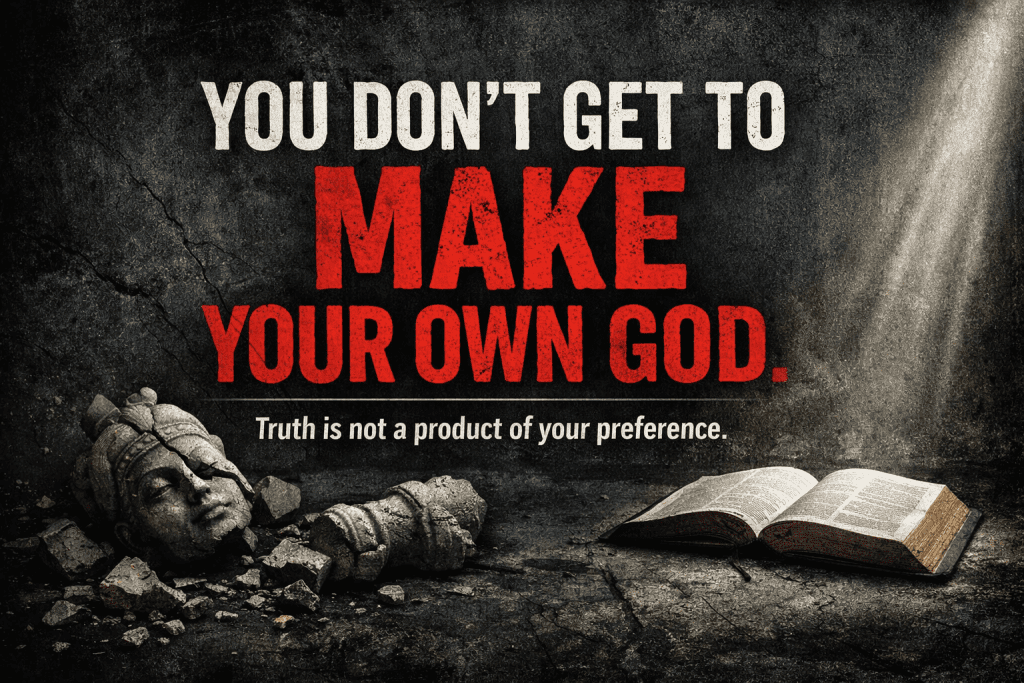
Tonight at jail ministry, I shared a message titled Sin Didn’t Just Hurt You — It Used You. For a few men in the room, it landed exactly where it needed to. You could tell they weren’t hearing a speech—they were hearing their own story being exposed.
For one person, it touched a nerve.
There was pushback. Not shouting or chaos. Just that familiar resistance that shows up when truth gets too close. Statements like, “Everybody has their own opinion of who God is,” “People can believe whatever they want and it’s fine,” and “There’s no proof Jesus is who Christians say He is.”
I’m not writing this to embarrass anyone. I’m writing because those lines aren’t just jail talk—those are modern culture in a nutshell. And if you’re reading this and you align with that “free will means it’s all acceptable” way of thinking, I want you to hear me clearly.
I have no skin in your game.
Whether you choose God as He has revealed Himself, or you choose a god shaped by your preferences, it does not change my eternity. It does not change my relationship with Jesus Christ. I’m not trying to win points. I’m trying to put truth on the table.
Because free will is real—but free will doesn’t make every belief true. It just means you get to choose what you’re going to answer to.
And that brings me to the core issue: authority.
When someone says, “I’ll believe in God my way,” it sounds open-minded. But what it really means is, “I’m the final authority.”
The problem is simple: if I get to define God, then God is no longer God. He’s a product. A projection. A customized comfort item.
And that kind of god never confronts sin.
That kind of god never calls for repentance.
That kind of god never has the right to say “no.”
That’s exactly why sin loves it.
Sin doesn’t just hurt you. It uses you. It trains you to stay in control, stay unaccountable, and stay spiritual enough to feel fine, but not submitted enough to change.
This is what I intend to share with the inmates—and I’ll tell you too: if we’re going to talk about God, we need a source that’s bigger than opinions.
That’s what Scripture claims to be. Not a collection of human guesses about God, but God’s revelation to man. And if you’ve never actually looked at how the Bible came to us, you may be rejecting it without understanding it.
Here are a few facts that matter.
The Bible Was Written Over About 1,500 Years
This isn’t one guy in a cave writing “his truth.” The Bible was written across roughly fifteen centuries, through different empires, different cultures, different political climates, different personal backgrounds.
That time span matters because it crushes the idea that Christianity was a quick invention or a single-man philosophy.
The Bible Has About 40 Authors — And Yet One Message
The authors weren’t all the same type of people.
You’ve got kings and peasants.
Warriors and poets.
Prophets and fishermen.
Government men and prison writers.
Highly educated and blue-collar.
And yet, the message is unified: who God is, what sin is, why mankind is broken, and how God rescues through Christ.
That unity across that much time and that many authors is not normal. You don’t get that by accident.
“Manuscripts” Isn’t a Church Word — It’s a History Word
When people say “there’s no proof,” what they usually mean is “I haven’t personally looked.”
The New Testament didn’t fall from the sky. It was copied, circulated, and preserved in handwritten documents. Those copies are called manuscripts. And here’s why that matters: historians evaluate ancient writings based on manuscript evidence—how many copies exist and how close they are to the original events.
We have a massive amount of New Testament manuscript evidence compared to most ancient works people accept without blinking. And the goal isn’t to claim we have the original ink-and-paper page Paul held in his hand. The goal is textual confidence—being able to compare copies across time and geography and know what the original said.
This is how ancient history works. Scripture isn’t exempt from scrutiny. It survives it.
This Is Bigger Than “Can I Believe It?” — The Real Question Is “Will I Submit to It?”
A lot of people hide behind “lack of evidence” when the real issue is authority.
Because if Jesus is who He claimed to be, then I’m not in charge.
If Scripture is true, then sin isn’t just “my struggle”—it’s rebellion.
If God is real, then repentance isn’t a suggestion—it’s a command.
That’s why people prefer “my version of God.” It lets them keep the throne.
The Decision You Can’t Avoid.
This is where I am going with the guys, and it’s where I’ll go with you:
Not choosing is still a choice.
Rejecting Christ is still a response.
Delaying obedience is still disobedience.
Silence is still an answer.
You will not stand before God and say, “I stayed neutral.” Neutrality is a myth people use to buy time. And time doesn’t save anybody.
Here’s the mercy: God putting truth in front of you is grace.
God does not owe anyone clarity. The fact that you’re even thinking about this is not an accident.
Here’s the warning: truth rejected hardens the heart.
Repeated resistance builds blindness.
And this line is blunt because it’s real:
Light rejected becomes judgment.
That’s not me trying to be harsh. That’s reality. Light either leads you, or it exposes you.
You can walk out holding confusion like a shield or you can walk out surrendered to truth. But you will not walk out neutral.
You don’t get to make your own God.
You only get to answer the real One.
Discover more from Scott A Marshall
Subscribe to get the latest posts sent to your email.
